The brief
A three-day design assignment for a product design internship: five to seven screens, one complete flow, one edge case. I kept the brief exactly as it was set.
Space Hitchhiking App — the full briefShow
Design an app that helps space travellers find passing spacecraft heading towards their destination and request a ride. Duration: 3 days.
Create a space hitchhiking app that helps travellers discover spacecraft already travelling towards or near their destination.
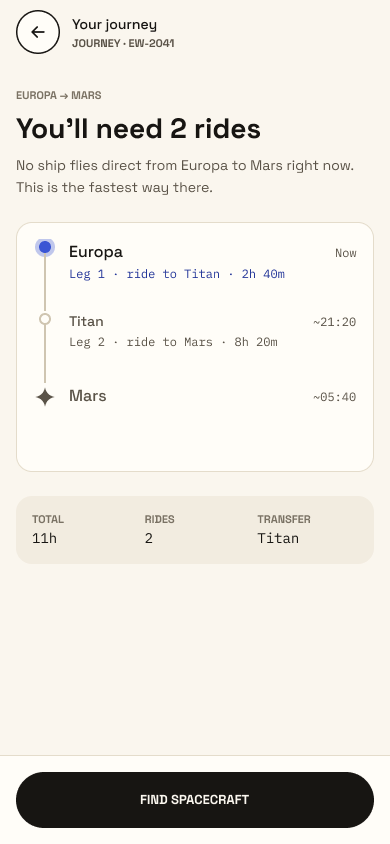
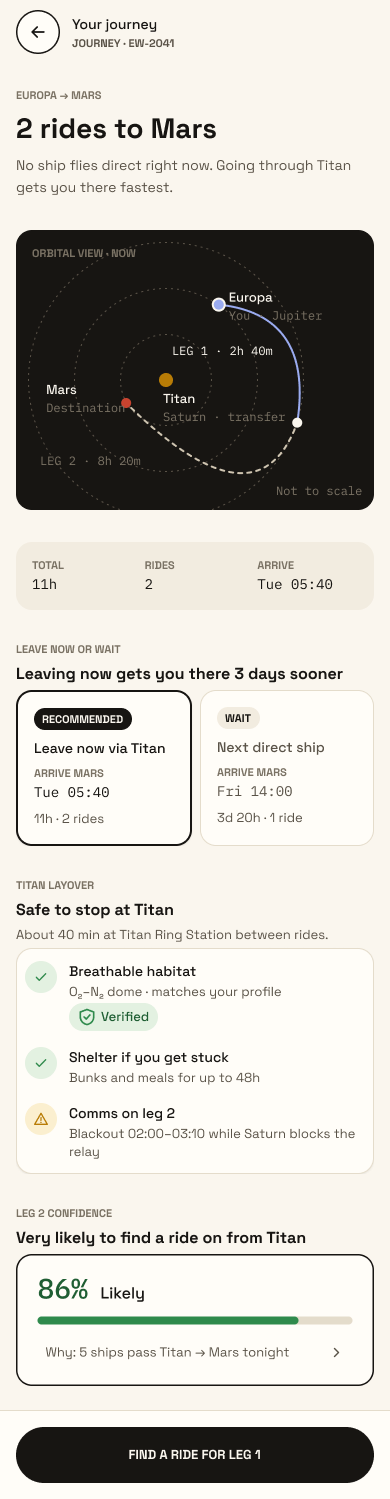
Focus on the core journey of finding a suitable spacecraft, understanding the journey, and requesting a ride. A traveller may need more than one ride to reach their destination, so consider how the experience can help them understand their overall journey.
Include one relevant exception or edge case, such as a declined request or a change in travel plans. The experience should be simple, intuitive, and visually engaging. Make reasonable assumptions about how space hitchhiking works and mention them clearly.
Design considerations
- Personas, design process and research
- Conclusions and solutions backed by clear reasoning
- Simplification and clarity of the solution
- User flow and wireframes good enough to communicate the journey
- Final UI design: 5–7 key screens covering one complete flow, with strong layout, typography, and visual design
Submission
- A link to your interactive prototype
- PDF of the designs with user flow
- A brief note highlighting key design decisions and assumptions
2
rides to Mars
6
key screens
3
edge cases
4
rounds of iteration
How I started
Almost no one has travelled in space, so interviews were out. I studied the people who had, on screen.
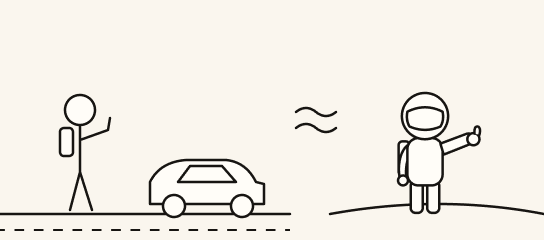
01 · An Earth parallel
A stranger, a spare seat, a shared direction. Space already does it with rideshare satellites and gravity assists.
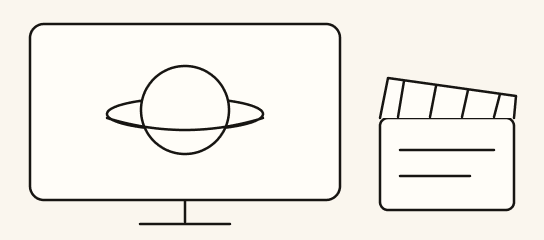
02 · Films as reference
The Martian, Project Hail Mary, Passengers, Interstellar. Abandoned, wary, alone.
03 · One hero
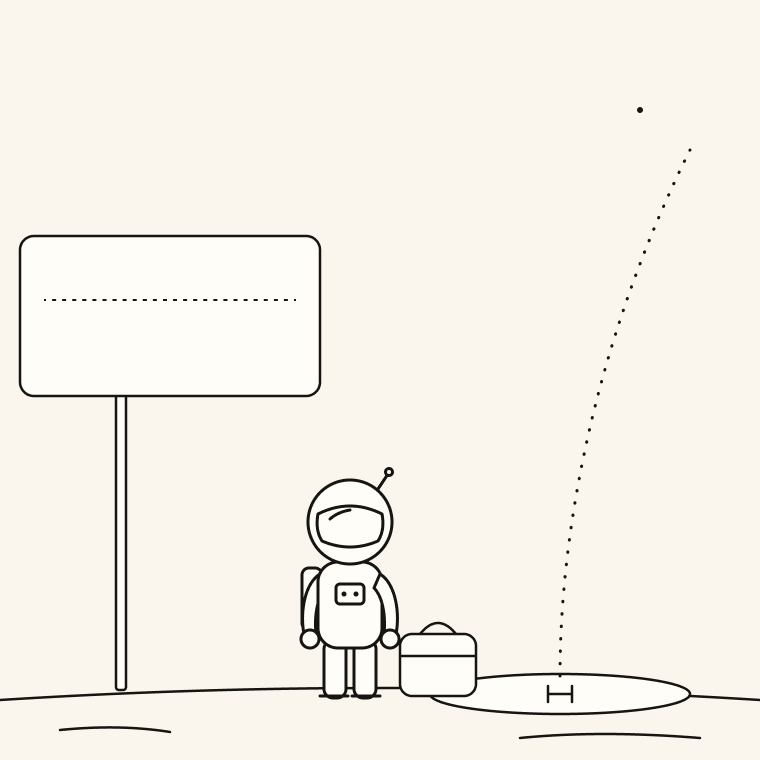
The most stranded one became the narrator: Mark, stuck on Europa, ride home gone.
The takeaway: the thumb becomes timing. You don’t wave a ship down. You get to the right place at the right moment.
The rules of my world
The brief said to assume, and say so. Five rules, each one shaping a screen.
01 · Life is out there
Many species travel between worlds.
02 · One network, one language
Translation happens at the communication layer.
03 · Safety before booking
Fit is checked before I ask. My body profile travels with me.
04 · Every ship is different
Crewed or autonomous. The card says which.
05 · Ships don’t stop
A pad shuttle meets them in orbit. Messages are letters, not chats.
Who is in this
Three people, one journey. Each one changes a screen.
Mark
Stranded · the hero
“I need to get out of here.” Needs certainty.
The planned traveller
Has a plan
“I want a better way there.” Seeks value and flexibility.
The captain
Owns the spare seat
“There’s room, if I can trust who I take.” Needs trust.
How might we help someone find a safe, compatible journey through an unpredictable interplanetary network?
Mark’s way home
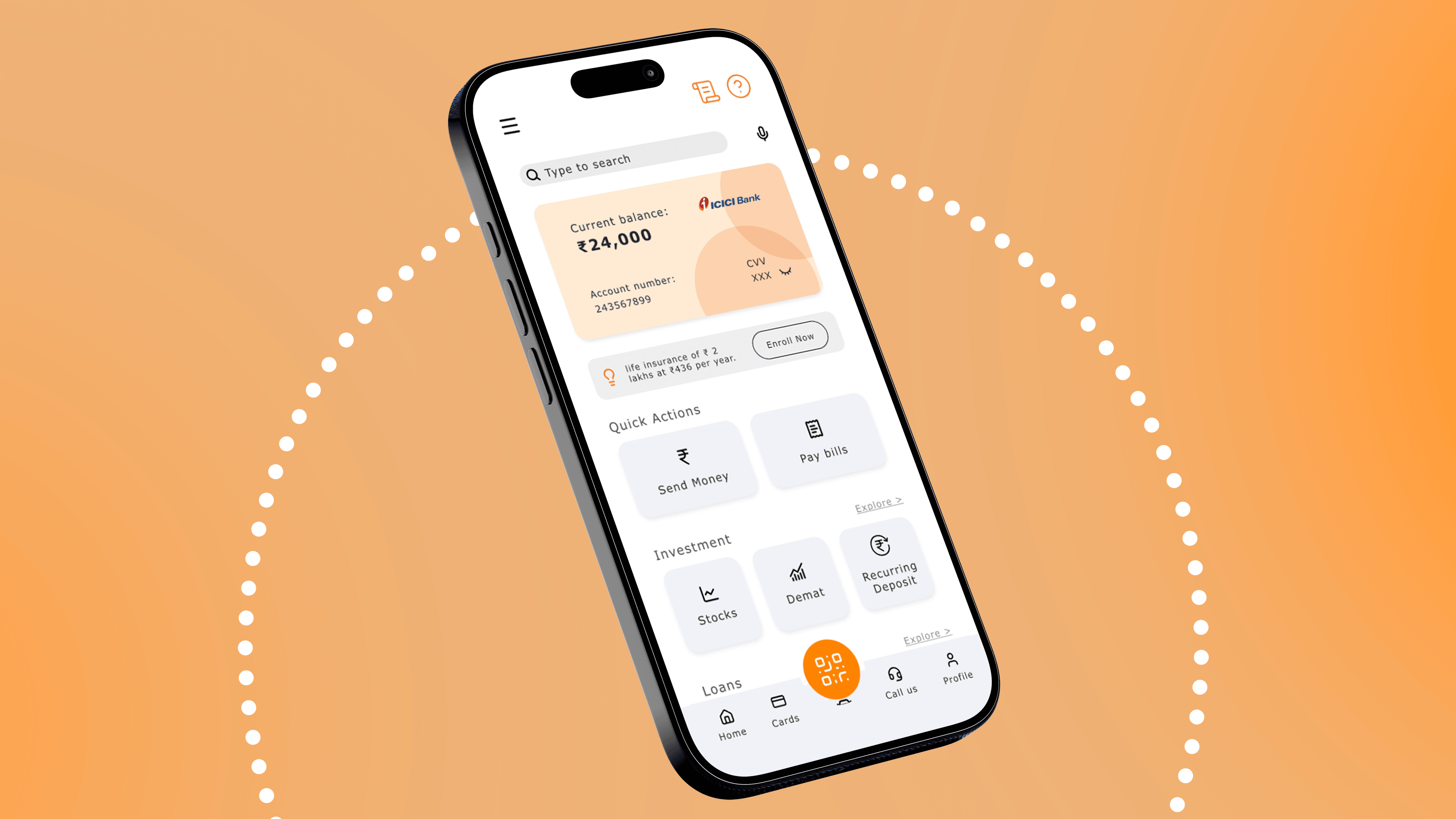
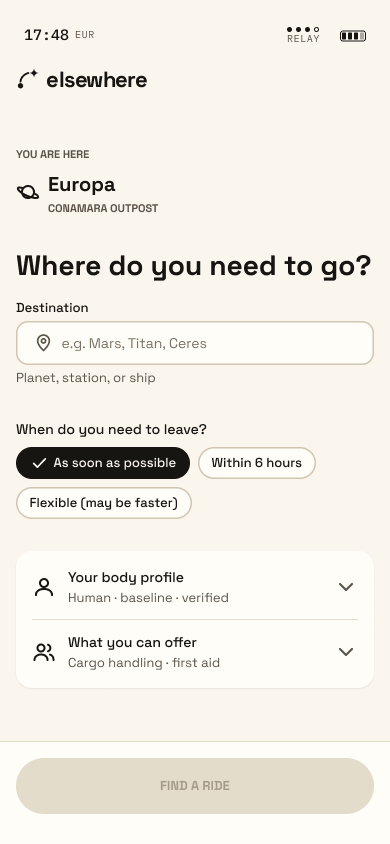
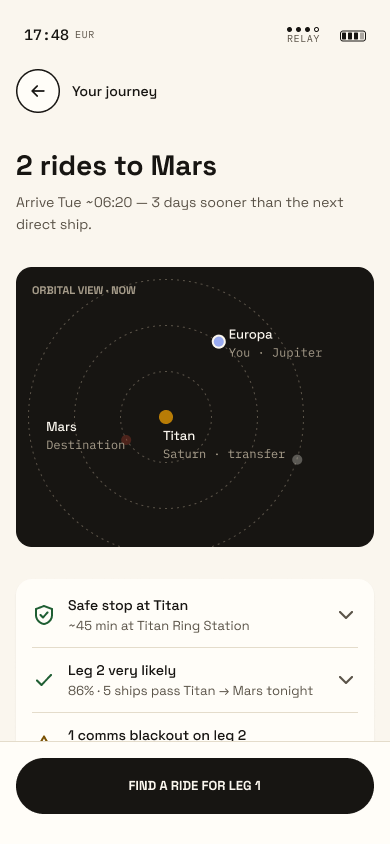
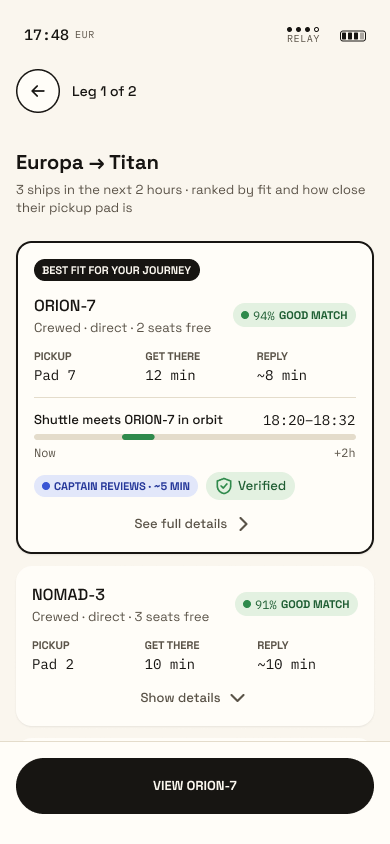
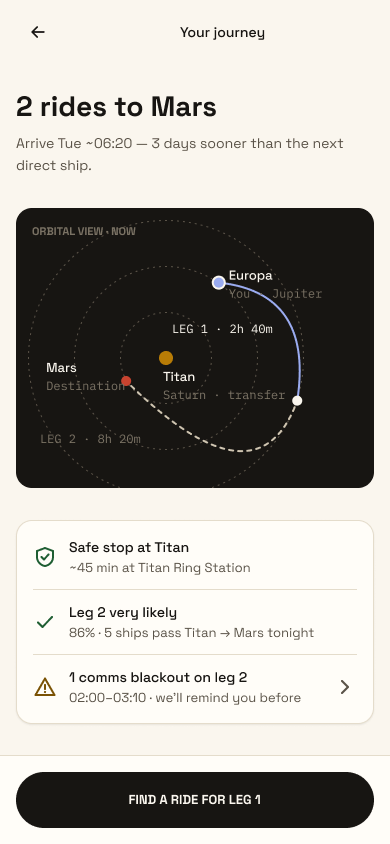
Mark’s ride home left without him. He needs Mars, today. Six screens take him from asking to arriving.
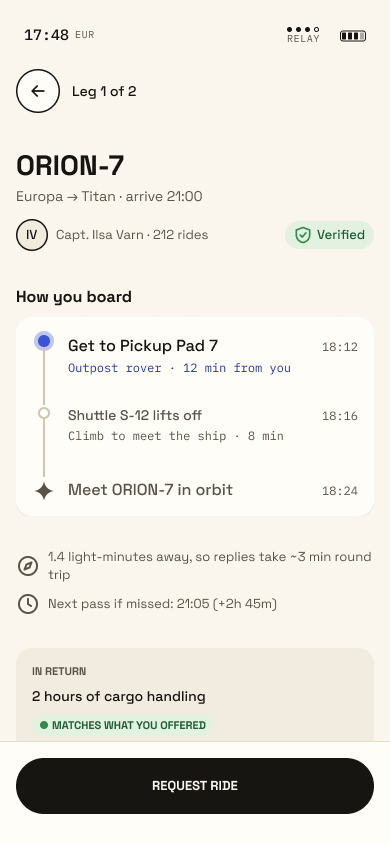
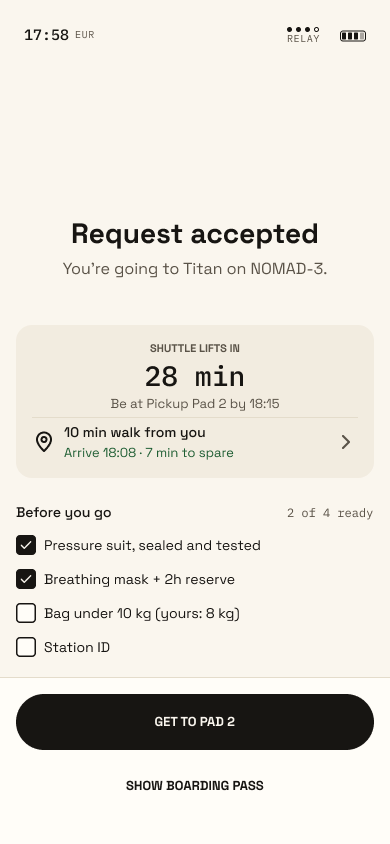
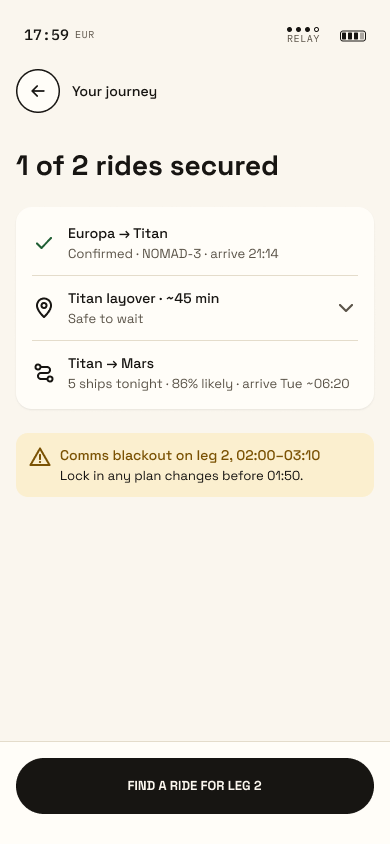
What made it trustworthy
Five questions Mark would ask, each answered on the screen.
- Who can I trust?
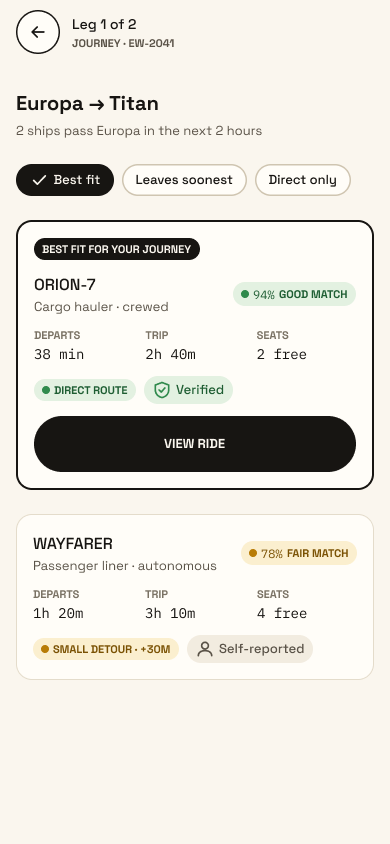
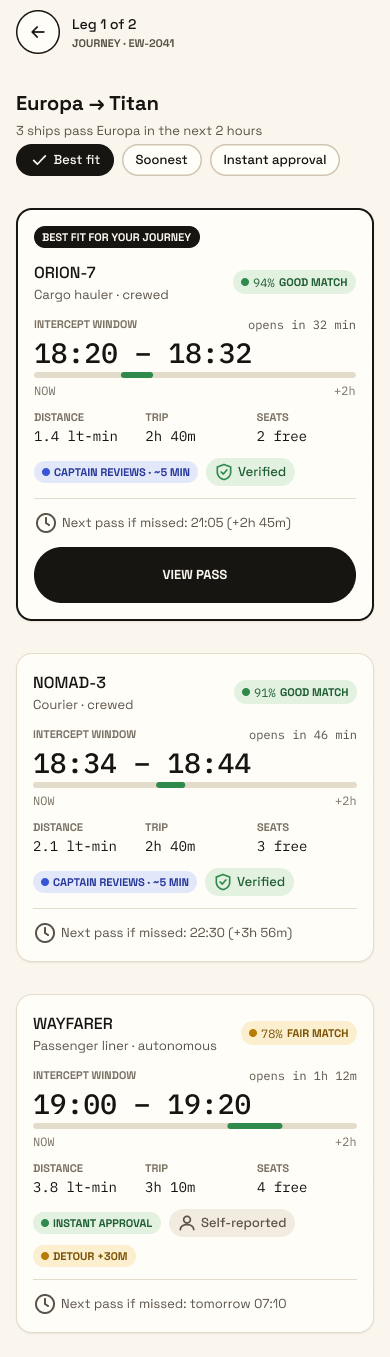
- Verified captains carry ride history. Self-reported looks different, never green.
- Can I travel with them?
- One match score, always with its reason. Full checks one tap away.
- Is the journey viable?
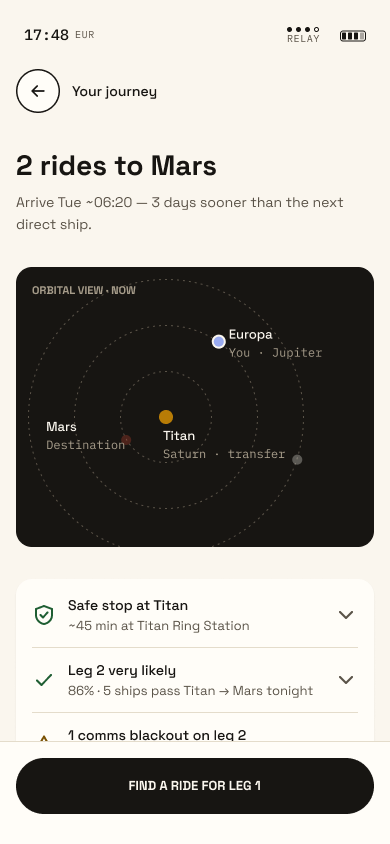
- Legs, layover safety, pickup pad and walk time, in one view.
- What happens next?
- Every state is named: sent, in transit, accepted. Reply times include light lag.
- I’m stressed.
- One clear action per screen, and a backup seat held before I have to ask.
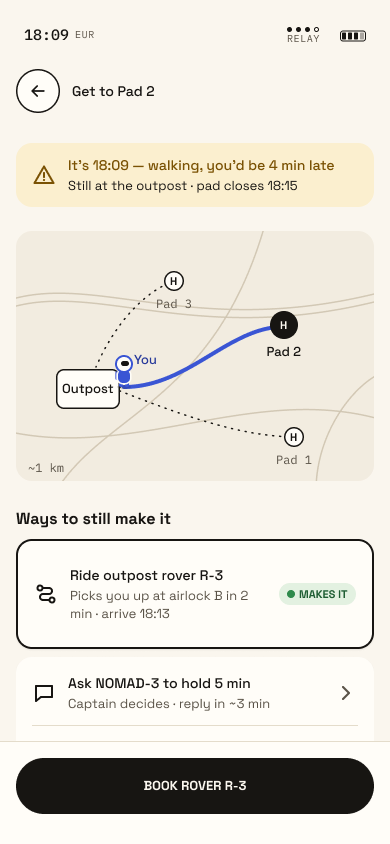
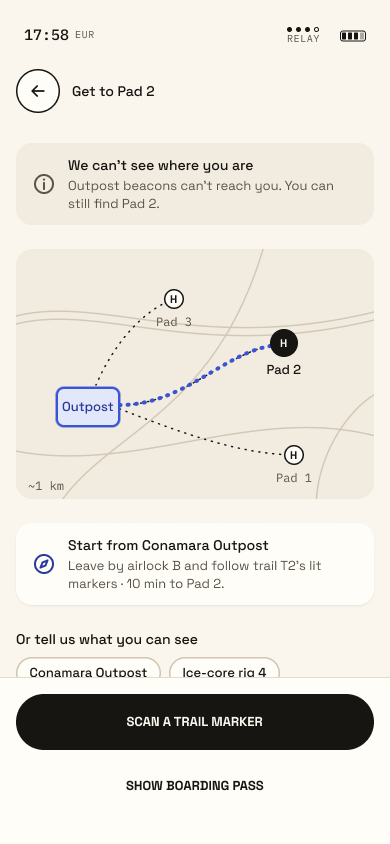
When it went wrong
The brief asked for one exception. Plans in space break more than once, so I designed three.
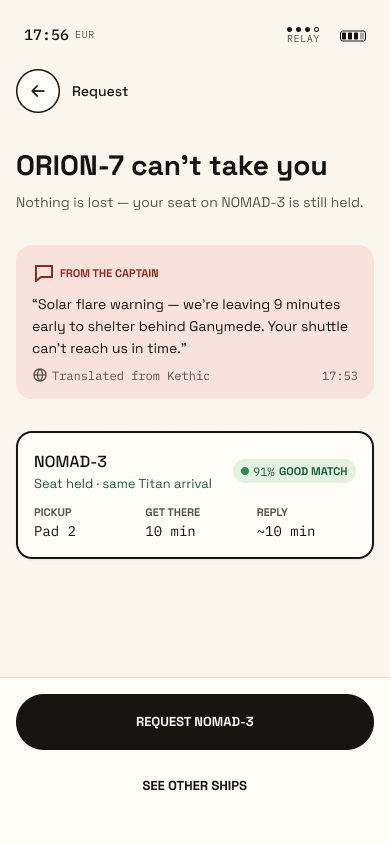
Four rounds
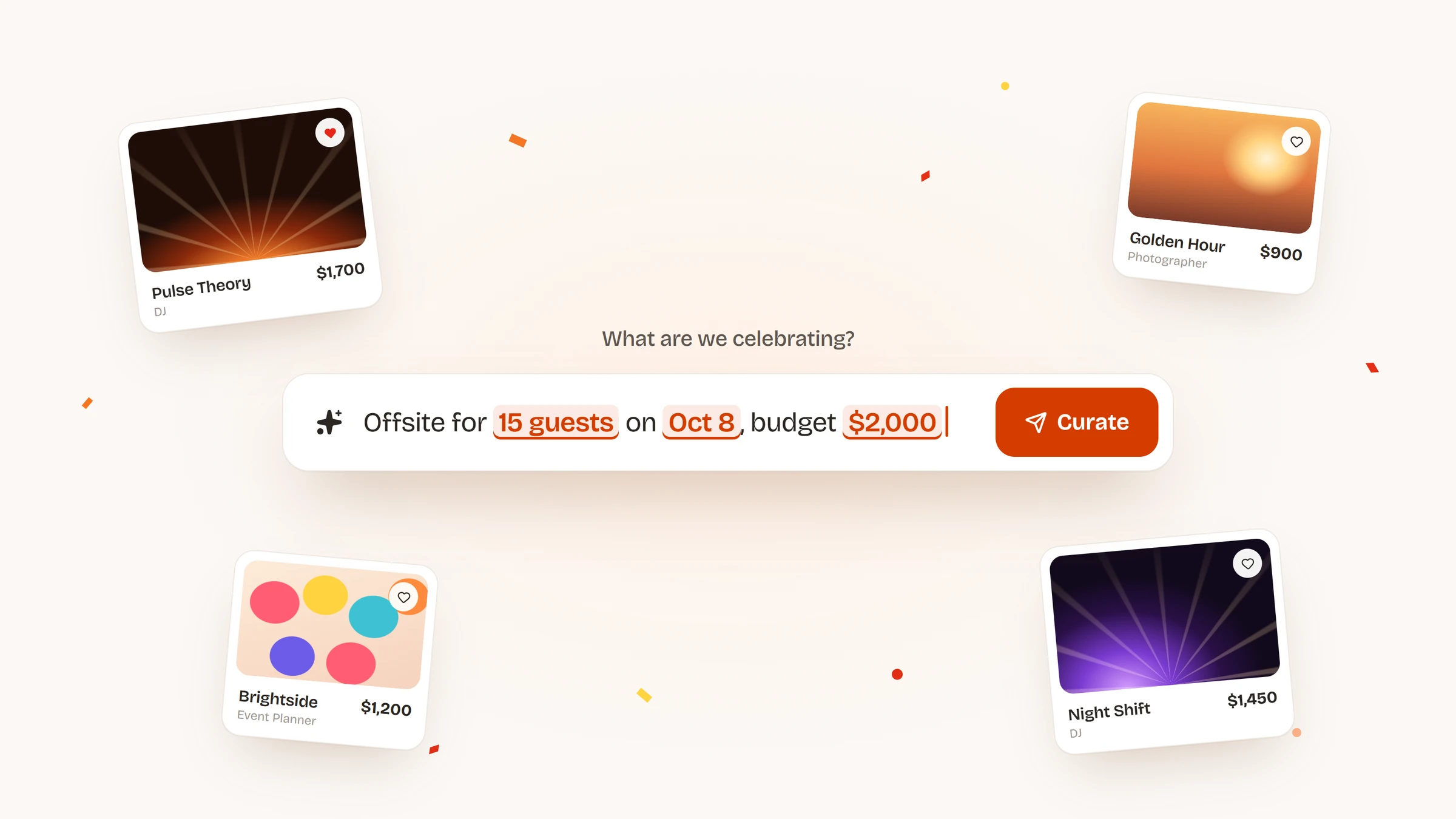
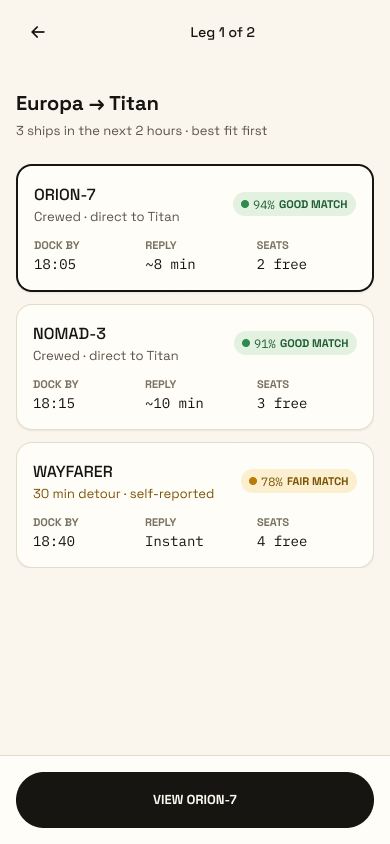
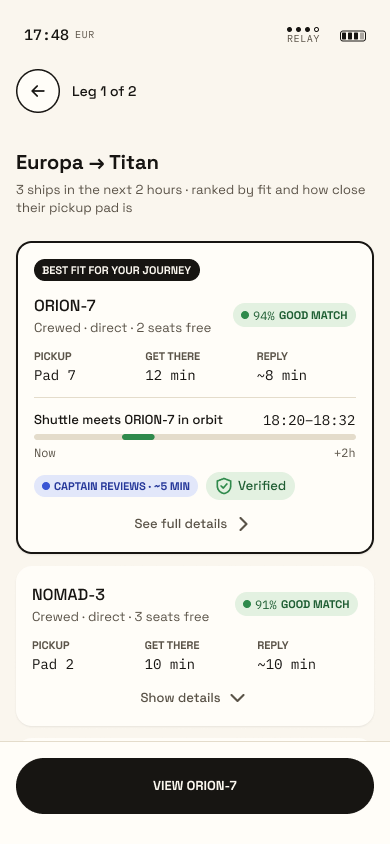
v2 answered everything and read as cluttered. v3 cut to answer first, then the reason, then the receipt. v4 kept v3 and let v2’s detail open on tap.
Your journey
Passing ships
What I cut, and what is next
Cut
- A voice companion. Real-time talk fights minutes of lag. Honest status does the reassuring.
- The Explorer persona. It changed nothing in the design.
- Suit air limits. Parked for later.
Next
- A real second leg. Titan to Mars, not an end screen.
- A usability test. Can someone who knows nothing about spacecraft get home?
- The captain’s side. The person who owns the seat.
What I take from it
It only felt like Uber until I let space in. A ride you can’t hail, a reply that arrives late, a body that has to survive the ship — each one changed a screen.